The RTM Handover Checklist: What a Newly Formed RTM Company Should Get From the Landlord
What a newly formed RTM company should get from the landlord when taking over management for the first time, what to ask for before takeover day, and the legal rights that help you get it.

This article is general information, not legal or financial advice. Always take qualified professional advice for your own building. This article covers the statutory Right to Manage process in England and Wales.
Your Right to Manage (RTM) company has been set up and takeover day is coming.
You are a volunteer director, you have a few weeks, and nobody has told you exactly what you are supposed to get from the landlord and their managing agent before you become responsible for running the building.
This article gives you the steps. It covers one specific situation: a newly formed RTM company taking over management from the landlord for the first time.
If your RTM company already manages the building and is changing managing agent, the handover works differently. The same applies to a Residents' Management Company (RMC). We cover those situations separately, see the FAQ below.
What Should You Get From the Landlord?
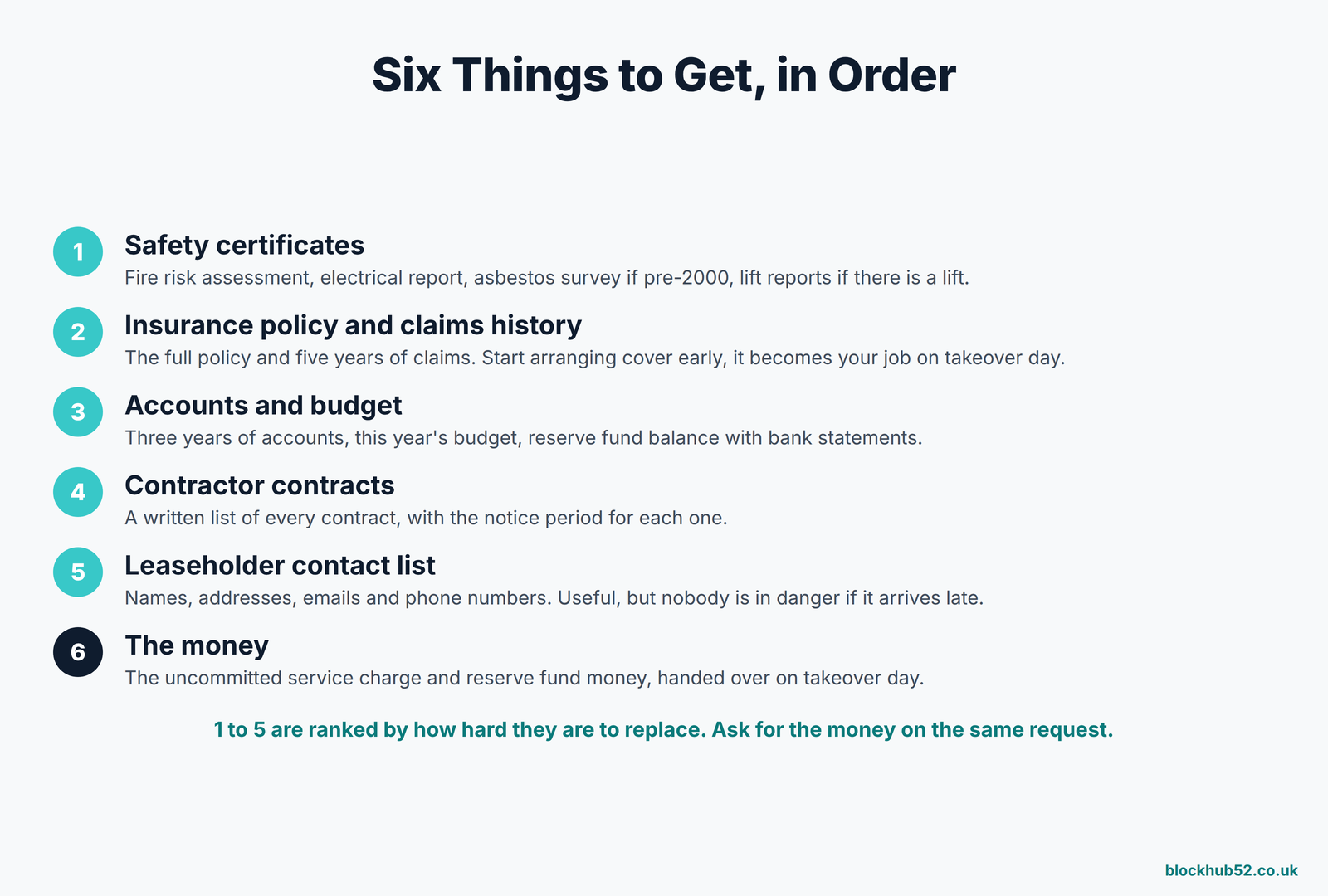
There are six main things you need to get under control before and during the handover.
- Safety records. Fire, electrical, asbestos, lifts and any other safety inspections that apply to your building.
- Insurance. The current policy, claims history and the information you need to make sure the building remains insured from takeover day.
- Accounts and budget. What has been collected, what has been spent, what is still owed and what bills or commitments are still outstanding.
- Contracts and ongoing work. Who currently provides services to the building, what work is underway and what arrangements you need to make for takeover.
- Leaseholder and building records. Leases, contact information, permissions, keys, access information and the records you need to manage the block.
- The money. The uncommitted service charge and reserve fund money that has to be transferred to the RTM company.
The landlord's managing agent will often hold most of the actual paperwork, but this is still a handover from the landlord's management to your new RTM company.
And there is one important thing to understand before you start asking for everything. Not all six items come to you under the same piece of law.
Four Legal Rights Worth Knowing Before Takeover
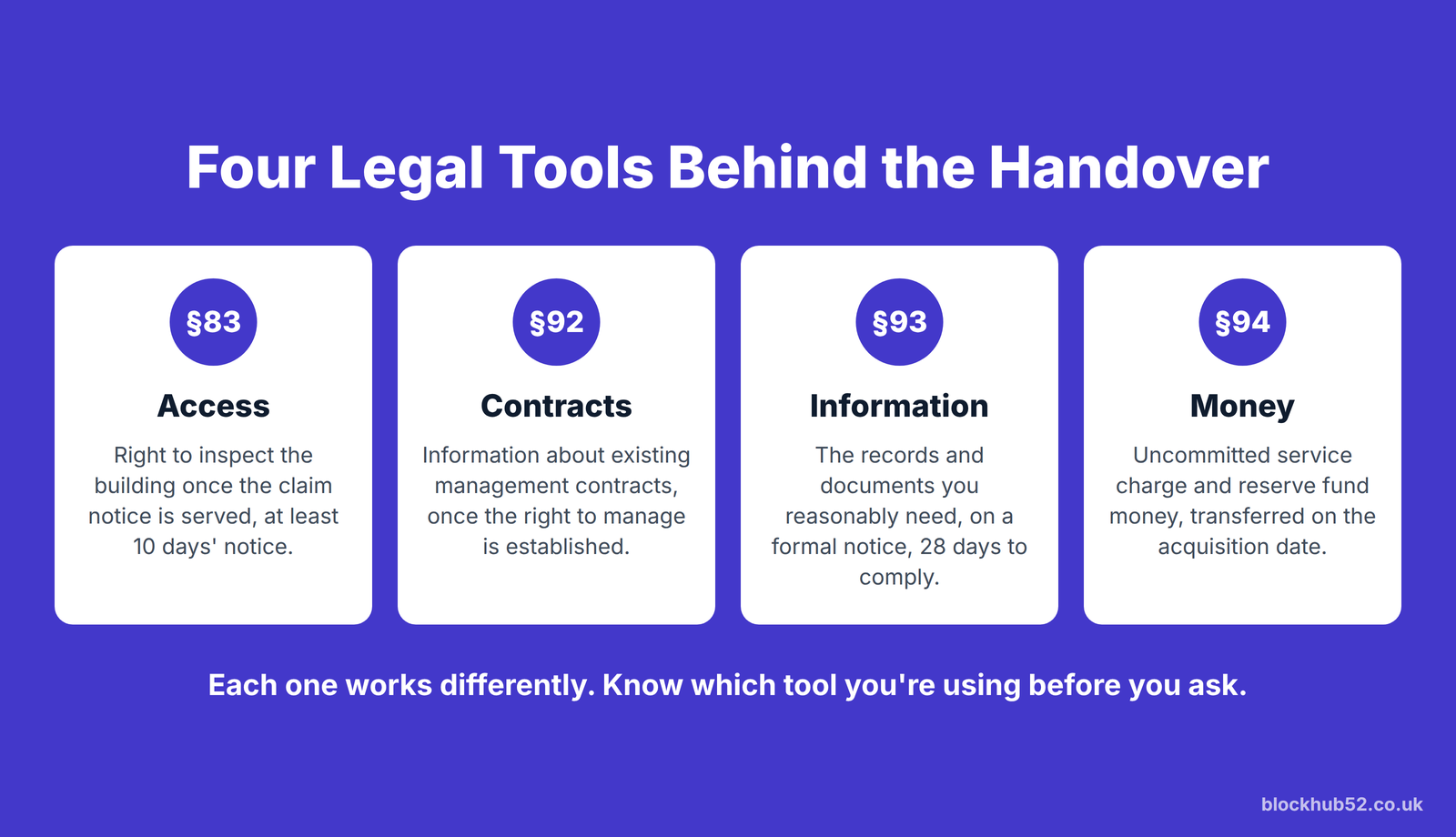
You do not need to become an expert in the Commonhold and Leasehold Reform Act 2002 (CLRA 2002). But there are four sections worth understanding because each one gives your RTM company a different tool.
Section 83: You Can Inspect the Building Before You Take Over
Once the RTM company has served its claim notice (formally told the landlord it is taking over management), the RTM has a right to get access to parts of the building that is reasonably needed in connection with taking over the management.
You normally need to give at least 10 days' notice.
This is useful because there may be parts of your own building that none of the new directors has ever seen.
Example: Your block has a lift, but the lift motor room is locked and only the managing agent's contractor normally goes inside. Do not wait until takeover day to discover what is in there. Your RTM company can arrange access before takeover and, if necessary, take a lift engineer or other professional with you.
The same might apply to:
- plant rooms
- communal boilers
- roof spaces
- water tanks
- electrical installations
- service cupboards

Documents tell you part of the story. Seeing the building tells you the rest.
Section 92: You Should Be Told What Contracts Are Already in Place
The existing manager has a legal duty to give information about the management contracts already in place once the RTM company's right to take over has been established.
The RTM company should therefore know which contractors are currently providing services before takeover.
The landlord's existing contracts do not automatically become your RTM company's contracts.
You need to decide which services you want to continue and which you want to change.
Example: The landlord currently has a lift maintenance contract. Section 92 should tell your RTM company who the contractor is and give details of the existing arrangement. That does not mean the contract simply changes its name to your RTM company on takeover day.
You now have time to contact the lift company and ask:
- Will you continue maintaining the lift for us?
- What will you charge?
- What contract will we need?
- When can the new arrangement start?
Or you can appoint somebody else. The important thing is that the lift does not reach takeover day with everybody assuming somebody else has dealt with it.
Section 93: You Can Ask for the Information You Reasonably Need
Section 93 covers the main handover information rights. It lets the RTM company serve a written notice requiring certain people to provide information that they have in their possession or control, and that the RTM company reasonably needs to exercise its right to manage.
This is where most of your handover checklist sits.
The key is that you must serve this on the correct entity. Often that will be the landlord, if not, then another company named as a party to the leases, or a manager appointed by a tribunal.
The landlord's ordinary managing agent may physically hold most of the paperwork, but that does not automatically make them the person you serve the Section 93 notice on. Serve the correct legal party and send the managing agent a copy as well.
If the information is contained in documents, the notice can require access to inspect them or receive copies.
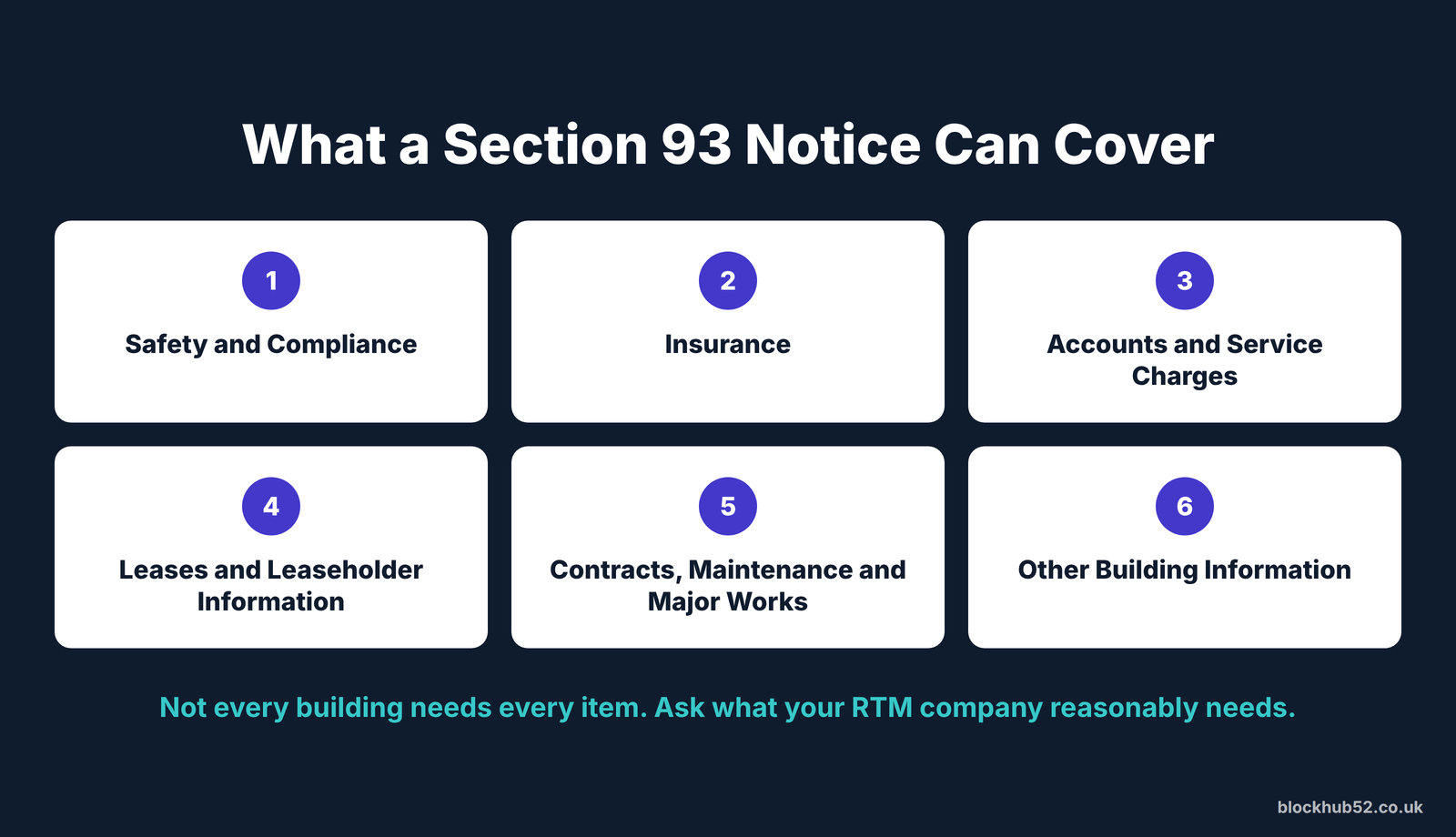
Example: Your RTM company is preparing to take over management of the building. Rather than waiting until takeover day, use the Section 93 notice to ask for the information and records you reasonably need as early as possible. Depending on your building, that may include:
Safety and Compliance
- The current fire risk assessment, in full, including the name of the person or company that carried it out
- The fire risk assessment action plan, showing what work was required, what has been completed and what is still outstanding
- Fire alarm, emergency lighting, fire door and other fire safety inspection and testing records for the last three years, where applicable
- The electrical inspection report for the common parts, including details of anything identified as dangerous, urgent or requiring further work
- The asbestos survey or asbestos register and asbestos management plan, where applicable
- The last two lift safety inspection reports, plus recent maintenance and breakdown records, if there is a lift. Comparing more than one report helps you spot faults that keep coming back
- Water hygiene and Legionella assessments and testing records, where applicable
- Communal boiler, gas or other plant safety and inspection records, where applicable
- Details of any outstanding safety notices, enforcement action or remedial work
- A list of all other safety inspections carried out on the building during the last three years, so you can identify any other records that should be handed over
These records are particularly important because some cannot simply be recreated from paperwork. If a fire risk assessment, asbestos survey or other important inspection record is lost, the RTM company may have to pay for a new inspection or survey. That costs money and, more importantly, can take time when you need the information to manage the building safely from day one.

Insurance
- The full buildings insurance policy, schedule and relevant endorsements
- The name of the insurer and broker
- The name of the policyholder
- The period the current premium has already been paid for
- Confirmation of whether the building has its own policy or forms part of a wider block policy
- The renewal date
- The claims history, usually five years
- Details of open insurance claims
- The latest reinstatement or rebuild valuation, if there is one
- Details of conditions the insurer requires the building to meet
Accounts and Service Charges
- The service charge accounts needed to understand the building's financial position, as a practical starting point, ask for the last three years where available
- The current service charge budget
- Actual spending against that budget
- The service charge ledger or transaction history
- Bank statements for the service charge accounts
- Reserve or sinking fund records and statements
- The latest bank reconciliations
- A schedule of service charge arrears
- Copies of relevant service charge demands already issued
- Details of unpaid supplier invoices and the process so far to collect funds
- Details of expenditure already committed but not yet invoiced
- Details of credits or refunds due back to the service charge account
- Details of any debt recovery or tribunal proceedings in progress
- Details of major works expenditure and any retentions still being held
Leases and Leaseholder Information
- A copy of every lease and any later variations
- The service charge percentage or apportionment for every flat
- Leaseholder names and correspondence addresses
- Email addresses and telephone numbers held and reasonably needed for managing the building
- Relevant records of subletting
- Permissions already granted under the leases that remain relevant
- Applications for consent that are still being dealt with
- Details of ongoing lease breaches, complaints or disputes
- Records of changes of ownership and notices of mortgages or charges, where relevant
- Which flats are owner occupied and which are let, where that information is held and relevant
Contracts, Maintenance and Major Works
- Copies of existing management and maintenance contracts where the RTM reasonably needs them
- Contractor contact details
- Maintenance schedules
- What service each contractor provides, how often it is provided and the current cost
- Contract start and end dates, including notice or termination provisions
- Details of any deposits or retentions
- Details of work already ordered but not completed
- Details of contractor disputes
- Section 20 papers relating to current long-term agreements
- Section 20 papers for major works that are underway, planned, or still relevant because of outstanding costs, defects, guarantees or disputes
- Specifications, surveys and proposals for planned major works
- Guarantees and warranties for work that remain in force
Section 92 separately deals with information about existing management contracts. Section 93 can be used to ask for the additional contract documents and information your RTM reasonably needs to decide what happens after takeover.
Other Building Information
- Relevant building plans and specifications
- Plant and equipment manuals
- Maintenance logs
- Information about keys, access codes, fobs and access arrangements
- Other information the RTM reasonably needs to take over management of that particular building
Not every building will have every item on this list. A small converted house with four flats will need much less information than a large block with lifts, communal heating and major works underway.
The test is: will your RTM company reasonably need this information to manage this building once it takes over? If the answer is yes, include it in the Section 93 notice.
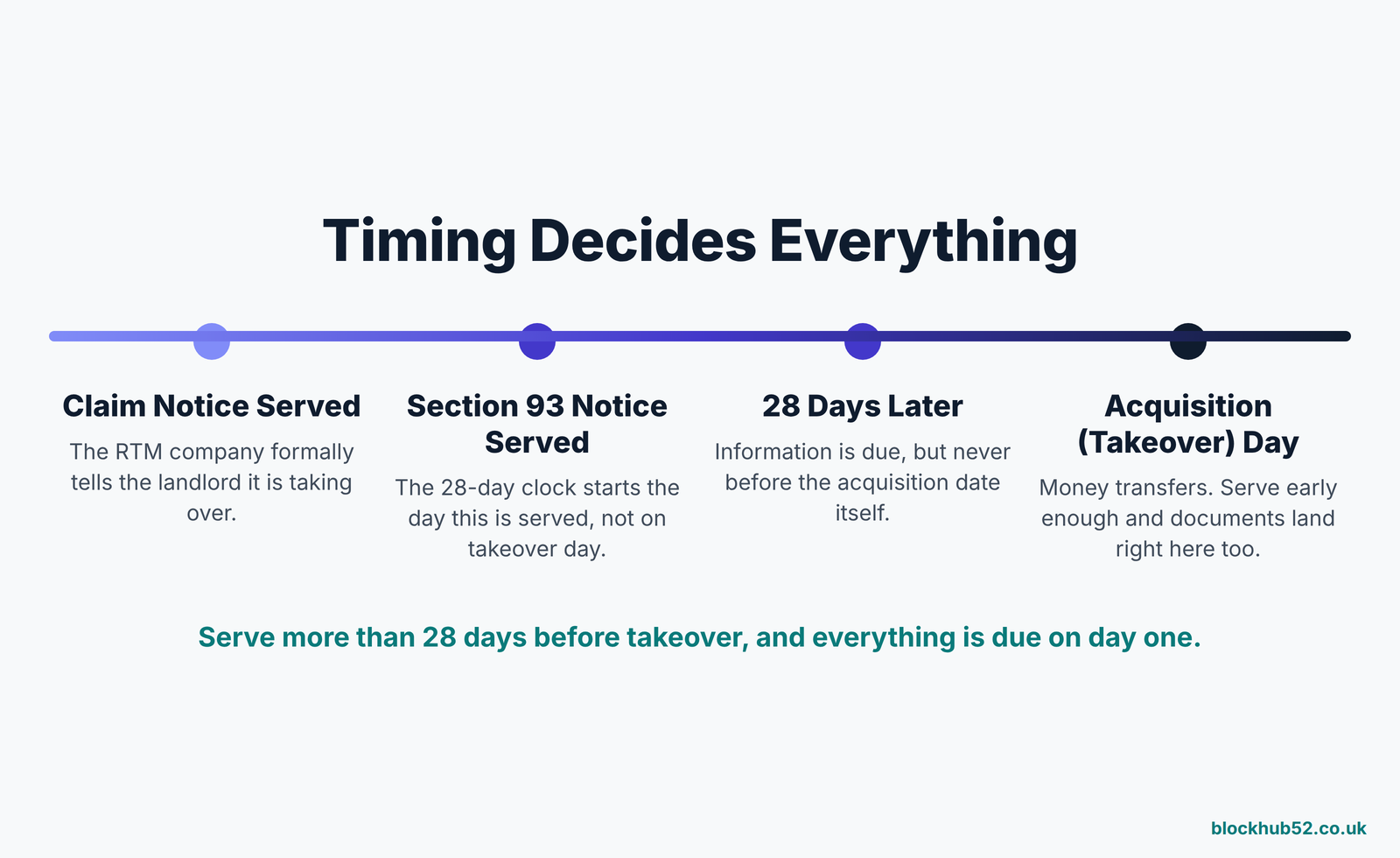
There is a 28-day period beginning with the day the notice is given. However, the notice cannot require the information to be provided before the RTM company's acquisition date.
That is why it makes sense to serve the notice early. If you leave it until takeover day, you could then be waiting another 28 days for information you need to run the building.
Section 94: Getting the Service Charge Money
Section 94 deals with something completely different. It deals with the money.
When the RTM company takes over, the accrued uncommitted service charges held at that point have to be transferred to the RTM company on the acquisition date, or as soon afterwards as is reasonably practicable.
In plain English, this starts with service charge money already collected, including qualifying reserve or sinking fund money and investments representing those funds. But it is not automatically every pound sitting in the bank. Amounts properly required to meet service charge costs incurred by the current manager before the RTM took over can be deducted.
Example: Suppose £30,000 is being held in the building's service charge and reserve funds. There is also a genuine £4,000 bill for work carried out before the RTM took over which still has to be paid. The starting point is not simply £30,000 in the bank equals £30,000 to the RTM. The pre-takeover cost has to be taken into account when the final transfer figure is calculated.
That is why you need the bank balance and the calculation behind the amount being transferred. You should ask for detailed accounting of what the current management will be holding back that includes invoices that are outstanding.
To check the transfer figure, ask for:
- the balance of every service charge account at takeover
- the reserve or sinking fund balance
- closing bank statements
- details of any investments and interest or investment income
- a breakdown of amounts being retained for pre-takeover costs
- the invoices or other evidence supporting those amounts
- details of costs incurred but not yet invoiced
- a clear calculation showing how the final transfer figure was reached
If the amount cannot be agreed, the tribunal can decide it.
How Do You Ask for the Handover Information?
From a practical point of view, create one master handover list containing everything you need. Send it early, keep it in writing, and create a system to track what you are owed and what you have received. If your building is large it may become quite complex.
But do not think of the whole handover as one legal request. The law works differently for:
- access under Section 83
- contract information under Section 92
- information and documents under Section 93
- money under Section 94
For the Section 93 information, make sure the notice is served on the correct person. That can include:
- a landlord under a lease of the whole or part of the building
- another party to a lease, other than the landlord or leaseholder
- a manager appointed under Part II of the Landlord and Tenant Act 1987
If the landlord employs an ordinary managing agent, the agent may physically hold nearly every file you want. Send them a copy of all correspondence, just in case, and record this. But do not assume that sending an email only to the managing agent is the same as properly serving a Section 93 notice.
Do Not Rely on an Ordinary Email
Email everybody involved if it helps get the handover moving. But for a statutory Section 93 notice, serve it properly in writing at the correct address and keep evidence of service.
You want to be able to prove:
- what you asked for
- who you served
- when you served it
- when the 28 days started
That written trail becomes very important if things do not arrive.
If you follow this system, both the entity you should serve the notice to and any managing agent know you are serious and will be less likely to just ignore you.
Just because this is law does not mean the parties will comply without a fight.
Why Does the Order Matter?
The first five items are roughly in the order of how difficult they are to replace.
Safety Information Is Hardest to Recreate
If your leaseholder contact list goes missing, rebuilding it will be irritating. If the fire risk assessment disappears, somebody may have to inspect the building again and produce another one. That costs money and takes time.
Insurance Needs Action First
Insurance is second on the paperwork list but probably the first thing you should start working on. You cannot leave the building uninsured while you wait for the handover information.
The Money Sits Separately
The money comes sixth, not because it matters least. Financially, it may be the most important item on the page. It sits separately because you are not simply waiting for a document. You are dealing with a specific statutory transfer under Section 94.
What Should You Check When the Handover Arrives?
By this point you have already identified what to request. Now the job is to check what has actually arrived, what it tells you and what still needs action.
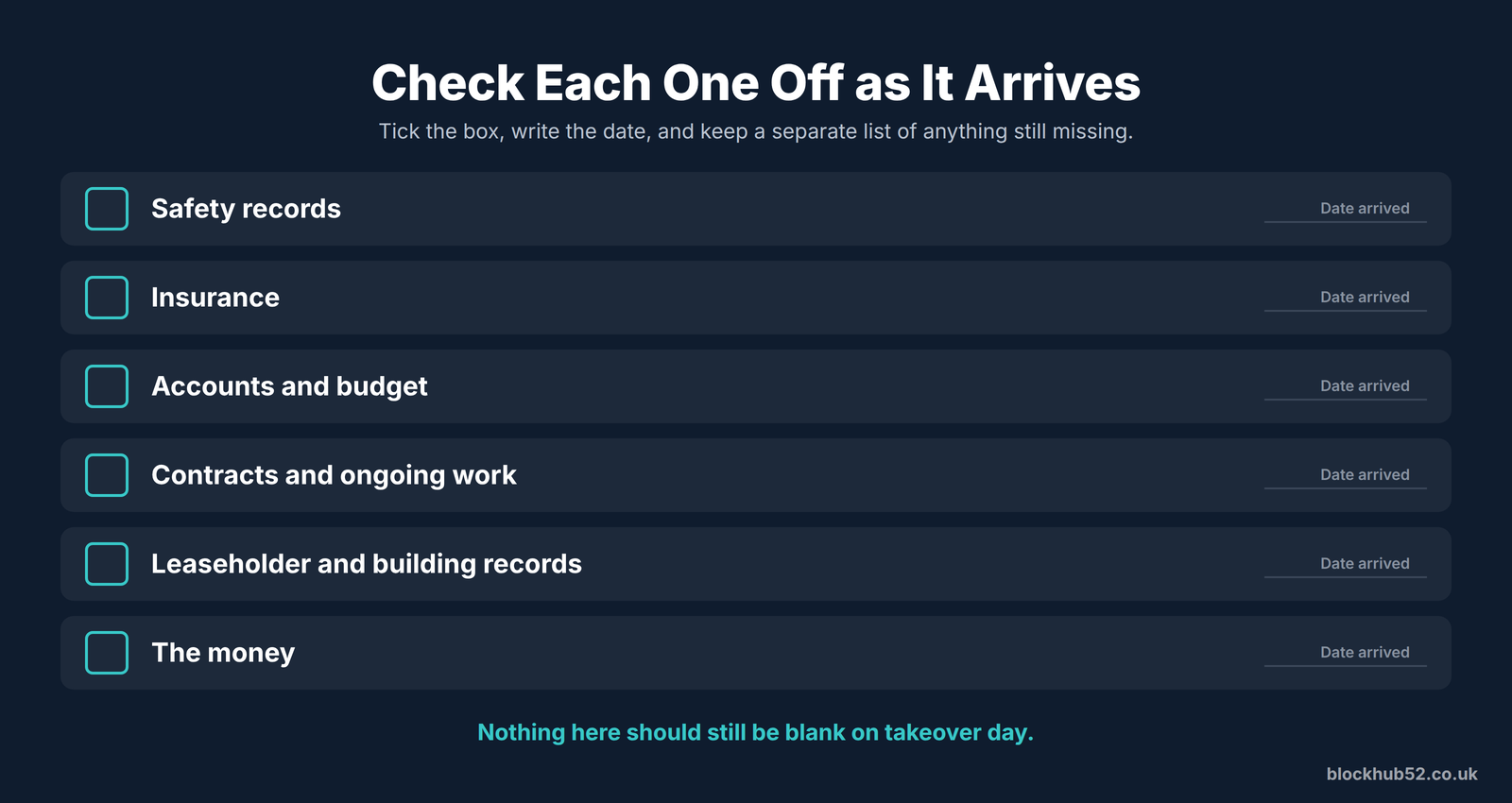
Tick each item off as it arrives, record the date, and keep a separate list of anything missing or unresolved.
1. Safety Records
Do not simply file the reports away. Read the action pages. A fire risk assessment with three overdue high priority actions is a very different handover from one with nothing outstanding.
Compare the history you asked for as well. Repeated lift faults, recurring fire safety issues or the same maintenance problem appearing in several reports can tell you much more than the latest certificate alone.
For asbestos, remember that the duty to manage applies to relevant common parts. Buildings built or refurbished before 2000 should be treated as potentially containing asbestos unless reliable information shows otherwise.
Inspect the Building as Well
This is where the Section 83 access right becomes useful. If you have never seen the roof, plant room, lift equipment or communal boiler, consider arranging an inspection before takeover. A beautifully organised handover file does not tell you that the roof is leaking.
Higher-Risk Buildings Need More
If your occupied building is in England and is at least 18 metres high or has at least 7 storeys, with at least two residential units, the higher-risk building regime under the Building Safety Act 2022 may apply.
An RTM company can be an Accountable Person and, depending on the building and repairing responsibilities, may also become the Principal Accountable Person. That brings additional responsibilities for building safety information and management.
This checklist is not a complete handover checklist for a higher-risk building. If your building falls into that category, get specialist advice before the acquisition date.
2. Insurance
Insurance needs attention early because the building has to remain properly insured when the RTM takes over.
Check the policyholder, renewal date, how much of the premium has already been paid, any open claims and any conditions the insurer requires the building to meet.
If the building sits inside a wider block policy, confirm with the broker or insurer what will happen to that cover when the RTM takes over.
Read the insurance clauses in the leases as well. They may tell you what has to be insured and how the insurance must be arranged.
The RTM company does not necessarily have to start an entirely new policy. If the insurer agrees, it may be possible to take over or continue the existing landlord's policy, particularly where takeover falls part way through an insurance year. This may be easier and give you time to do a full review before the next renewal.
The important point is: make sure valid buildings insurance is in place from the acquisition date.
What if You Do Not Have the Claims History Yet?
Contact the existing broker early. Explain that the RTM company is taking over management and ask what information or authority they need.
The existing policyholder may need to authorise release of the claims history. At the same time, ask prospective insurers what they need before they can quote or put cover in place.
Do not leave this until the final fortnight.
3. Accounts and Budget
The paperwork is only useful if it lets you understand the financial position you are actually taking over. You are trying to answer four simple questions:
- How much money should there be?
- How much money is actually there?
- What bills still have to be paid?
- What money is still outstanding?
Compare the current budget with actual spending. That can show you that the building is heading for a shortfall before you have issued a single demand yourself.
Reconcile the bank statements and reserve fund records against the accounts, and check unpaid invoices, committed expenditure, major works costs and any retentions still being held.
Check the service charge percentages against the leases rather than assuming the previous spreadsheet is right.
Do Not Treat Old Arrears as Cash
If the previous accounts show that leaseholders owe £10,000, do not automatically put £10,000 into your new RTM cash flow forecast. Arrears are not money sitting in the bank.
The legal position around pre-acquisition costs and old arrears can also depend on when the costs were incurred. Understand what your RTM company will actually be entitled to collect before relying on those arrears.
4. Contracts and Ongoing Work
Make a day-one service list. Cleaning, lift maintenance, fire systems, communal heating, door entry and other essential services should not stop because everybody assumed the old arrangement would carry on.
Compare the Section 92 contract information with the extra documents you obtained under Section 93. Check the service, price, frequency, contract dates and termination provisions before deciding what happens next.
The Existing Contracts Do Not Automatically Become Yours
Do not assume that because ABC Cleaning cleans the block on Friday now, ABC Cleaning will automatically turn up on Friday after your RTM takes over. Your company needs to decide what happens next.
- keep the same contractor under a new arrangement
- negotiate different terms
- appoint somebody else
- manage the service yourselves where appropriate
For any new agreement your RTM company enters into, record the renewal and notice dates immediately.
Check the Section 20 Files
Make sure the file is complete enough to show what consultation took place, including the notices, estimates, leaseholder observations and responses, notices of reasons, any dispensation application and anything still underway.
Section 20 consultation is normally required where a qualifying long-term agreement lasts more than 12 months and any one leaseholder will contribute more than £100 in a year. For qualifying works, consultation is normally required where any one leaseholder will contribute more than £250.
If the Section 20 consultation requirements were not met, recovery from an individual leaseholder may be limited to those figures unless the tribunal grants dispensation.
And one important warning: do not assume that consultation carried out by the landlord automatically covers a new contract your RTM company decides to enter into. If your RTM company is going to enter into its own qualifying agreement or start qualifying works after takeover, check what consultation you need to carry out yourselves.
Our free compliance guide sets out the recurring deadlines a block has to meet, including a wall chart with space to add your own dates. Get the free compliance guide here.
5. Leaseholder and Building Records
This is the day-to-day management history of the building, not just a contact list.
Check that correspondence addresses are usable, open applications and permissions are clearly recorded, and any ongoing lease breaches, complaints or disputes have enough history for the RTM company to pick them up without starting again.
Test the practical handover too. Make sure keys, master keys, fobs, access codes and plant-room access actually work before the outgoing management disappears.
Correspondence addresses are particularly important. Service charge demands and statutory notices need to reach the correct people.
Do Not Collect Personal Information Just Because It Exists
Section 93 covers information the RTM company reasonably needs. It is not a right to every piece of personal information the managing agent has ever collected.
Once personal information is transferred to your RTM company, you also become responsible for handling it properly under data protection law. Ask for what you need to manage the building. Keep it secure.
6. The Money
Section 94 has already told you what should transfer. At handover, the practical job is to reconcile the figure rather than accept one unexplained number.
Compare the closing service charge bank statements, reserve fund balance, investments and interest with the calculation you have been given.
Check every deduction for pre-takeover costs against the supporting invoices or evidence, including costs incurred but not yet invoiced.
If the amount cannot be agreed, either side can ask the tribunal to determine it.
Have Your Bank Account Ready Before Takeover
Do not wait until somebody asks where to send the money. Service charge funds are not simply ordinary company income.
Where the statutory trust rules apply, service charge and reserve fund money is held on trust for the purposes set out in the leases and legislation.
Make sure the RTM company has appropriate service charge banking arrangements that fit the trust account laws ready before takeover. This may involve two trust bank accounts, one for day-to-day service charges and one for the reserve fund or sinking fund. It is our recommendation that you create two trust bank accounts from day one. It will be so much easier to manage the two funds.
Do not simply mix service charge funds into the RTM company's ordinary operating money.
What Does Right to Manage Actually Transfer?
Right to Manage transfers management, not ownership. The freeholder still owns the freehold. Ground rent still belongs to the freeholder.
From the acquisition date, however, the RTM company takes over the management functions that would otherwise sit with the landlord under the leases. These commonly include:
- repairs
- maintenance
- common parts
- services
- buildings insurance
- service charge budgeting and collection
- service charge accounting
- managing contractors
- many approvals under the leases
- the legal and safety responsibilities that come with managing the building
For the functions that transfer, the freeholder does not simply carry on managing them independently in the background. But not every landlord function transfers. For example, some matters relating to forfeiture or re-entry remain with the landlord, and there can be other exclusions depending on the building and leases.
So the freeholder does not disappear. What changes is who manages the building.
What if the Landlord or Their Managing Agent Does Not Cooperate?
Do not let a bad handover drift. Keep everything in writing and escalate it in stages.
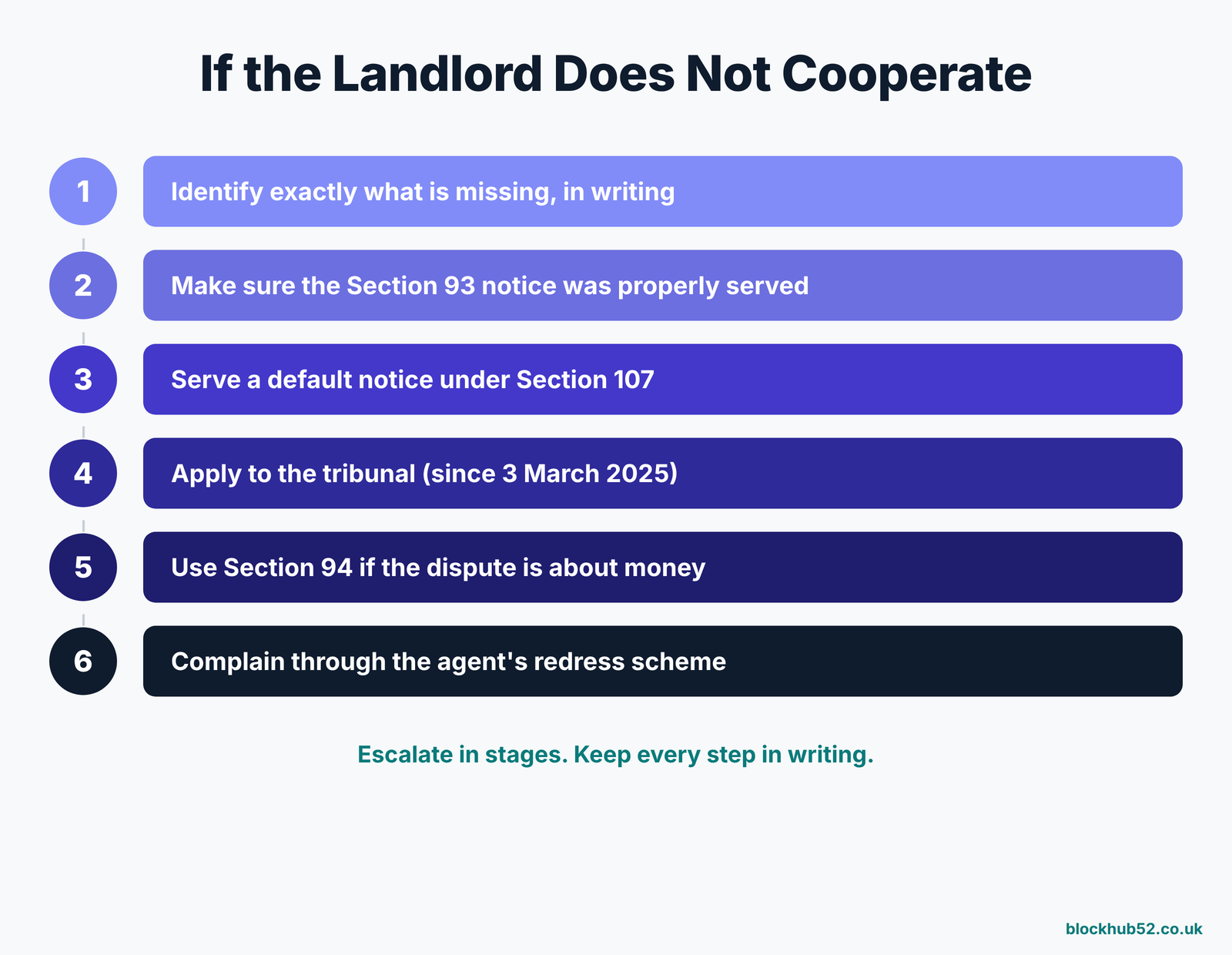
- Identify exactly what is missing. Do not write "Please send the outstanding documents." Write "We are still missing the current fire risk assessment, the 2025 service charge accounts and the reserve fund bank statements." Specific requests are much harder to ignore. If you are running a check system like a spreadsheet, you can even attach the document. If they know you are organised and not going away, you have a better chance of getting all the information you need.
- Make sure the Section 93 notice was properly served. An informal request may get the paperwork moving. A properly served statutory notice gives you an enforceable right. This should be done as soon as possible.
- Serve a default notice if necessary. Where somebody has failed to comply with an obligation under the RTM provisions, Section 107 provides an enforcement route. Before applying for an order, the person in default must first be given notice requiring them to put the default right, and more than 14 days must pass without compliance.
- Apply to the tribunal. Since 3 March 2025, the appropriate tribunal, rather than the county court, is the first place to apply for an order requiring compliance under Section 107. Older guidance may still refer to the county court, but this is no longer accurate.
- Use Section 94 if the dispute is about the money. If the disagreement is specifically about how much accrued uncommitted service charge money has to be transferred, either side can ask the tribunal to determine the amount.
- Consider the managing agent's complaints route. If the practical problem is the conduct of the landlord's managing agent, you may also be able to complain through their redress scheme or professional body. That does not replace your statutory rights. Sometimes it simply gets somebody to open the filing cabinet.
Frequently Asked Questions
How long does the landlord have to hand everything over?
There is not one deadline for the entire handover. For information properly requested under Section 93, the normal period is 28 days beginning with the day the notice is given. But the notice cannot require the information to be supplied before the acquisition date of the new RTM company. Section 92 contract information should come earlier, once the RTM company's entitlement has been determined. Section 94 money is due on the acquisition date or as soon afterwards as is reasonably practicable.
Can we just email the landlord?
Do not rely on an ordinary email as your only method of serving a Section 93 notice. Serve the written notice properly at the correct address and keep evidence. Then email copies to the landlord and managing agent as well. Making it easy for everybody to see what you want is sensible. Relying on an informal email for your legal position is not.
Can we ask for information before takeover day?
Yes, and you should. Serve the Section 93 notice early. It cannot require the information to be supplied before your acquisition date, but serving it early allows the 28-day period to run before takeover. The Section 92 contract information should also be coming to you before takeover. Nothing prevents the landlord or managing agent from voluntarily giving you documents earlier.
Can we inspect the building before takeover?
Yes. After the RTM company has served its claim notice, Section 83 gives it a right of access where reasonably needed in connection with the RTM claim. You normally need to give at least 10 days' notice. This is particularly useful for parts of the building directors may never normally see, such as plant rooms, roof spaces or lift equipment.
What is the most urgent item?
Insurance. Your building needs valid buildings insurance from the acquisition date. Start dealing with it well before takeover.
What if the insurance claims history has not arrived?
Contact the existing broker early and explain the RTM handover. Ask what authority they need and what information they can provide. At the same time, ask prospective insurers what information they require before providing cover. Do not wait for the final week.
How many bank statements should we ask for?
As a practical handover, ask for three years where they are available. This allows you to compare the bank records with the accounts and understand movements in the reserve fund. At the very least, get enough bank information to reconcile the latest accounts and prove the balance being transferred at takeover. Ask for each account separately.
Can individual leaseholders get anything before takeover?
Yes. Leaseholders have separate rights under the Landlord and Tenant Act 1985 to request certain service charge and insurance information. Those are different from the RTM company's Section 93 rights. They will not necessarily produce the entire handover pack, but they can be useful while you are preparing.
What if the managing agent says the fire risk assessment belongs to them?
A fire risk assessment should not disappear because management changes. Fire safety law requires relevant fire safety information to pass from an outgoing Responsible Person to an incoming Responsible Person. It is also the sort of management information an RTM company may reasonably require under Section 93.
Our RTM already manages the building and is just changing managing agent. Does this apply?
Not directly. This article covers a newly formed RTM company taking management from the landlord for the first time. If your RTM already manages the building, you are not acquiring the right to manage again. Your outgoing managing agent has been working for your RTM company, so the handover is mainly governed by your management agreement and the agent's obligations to your company. That is a separate handover scenario.
We are an RMC rather than an RTM. Does this apply?
Not directly. An RMC normally gets its management role through the leases rather than acquiring the statutory Right to Manage. If an RMC changes managing agent, its handover rights will mainly come from the leases, its management agreement and the relationship between the RMC and its agent. That is also a separate scenario.
Getting the Handover Right
A handover is the moment a building's entire history either moves somewhere organised, or scatters across three volunteers' laptops and a box in somebody's spare room.
The directors who come after you will eventually be standing exactly where you are now. Whether they inherit a working system or a shoebox is decided by what you do with the handover.
Do not just collect the information. Organise it. Date each item as it arrives. Record what is missing. Record the outstanding actions in the safety reports. Record the new contract dates. Reconcile the bank balances. Make sure the insurance is live. And make sure somebody knows what needs to happen next.
Where to Start
Start with the six:
- Safety records
- Insurance
- Accounts and budget
- Contracts and ongoing work
- Leaseholder and building records
- The money
Then remember the four legal tools behind the handover:
- Section 83 — access to inspect the building
- Section 92 — information about existing management contracts
- Section 93 — the information and documents your RTM reasonably needs
- Section 94 — the transfer of the service charge money
Once those four are clear, the handover becomes much easier to manage.
Turn the Handover Into a Working System
Getting the documents is only the first step. The next job is making sure nothing gets lost, expires or quietly gets forgotten.
BlockHub52 helps RTM directors keep the building organised during and after handover. You can see what documents you have, what is still missing, what needs action and what compliance dates are coming up.
With BlockHub52 Autopilot, the aim is simple: instead of directors having to remember every certificate, inspection, renewal and follow-up themselves, the system keeps track of what needs attention and helps make sure it gets done.
So the handover does not end up as a folder full of PDFs that nobody looks at again.
Related Reading
BlockHub52 provides general information only. Nothing here is legal or financial advice. Always take independent qualified advice for your own situation.