RTM vs RMC: What's the Difference and Why It Matters
RTM and RMC sound the same but they're not. A plain-English guide to where each gets its powers, and what that changes day to day.

Two leaseholders can run near-identical buildings and have completely different powers, because one is a Residents' Management Company (RMC) and the other is a Right to Manage (RTM) company. People use the two terms as if they mean the same thing. They don't. Which one you are decides where your powers come from, what you can do without the freeholder, and what happens when a leaseholder won't play by the rules.
This article is general information, not legal or financial advice. Always take qualified professional advice for your own building.
The Short Version
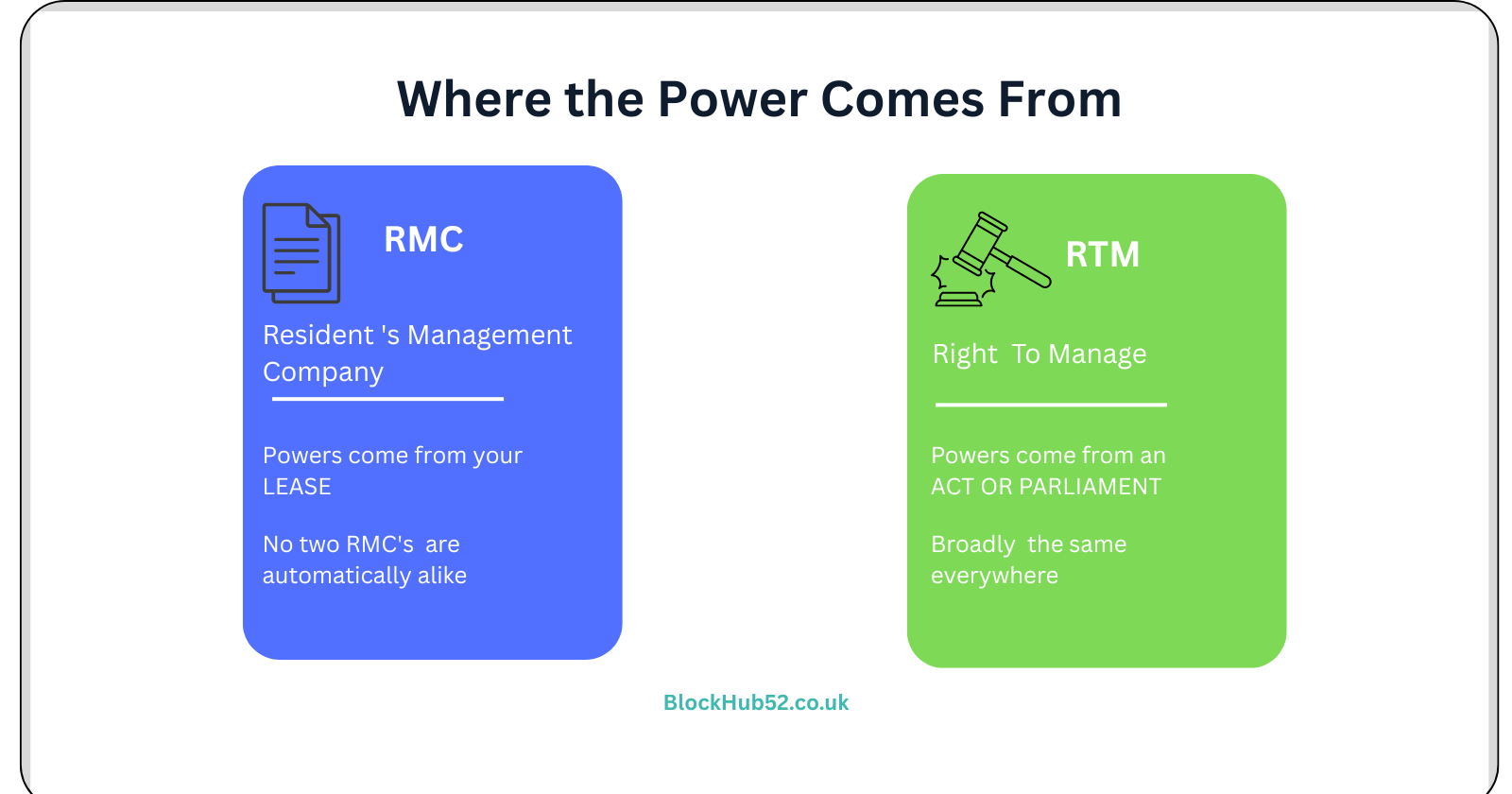
An RMC gets its powers from your lease. An RTM company gets its powers from an Act of Parliament. Everything else, how you were formed, what you can do alone, how you deal with the freeholder, follows from that one difference.
Residents' Management Company (RMC): a company that manages the building under the terms of the lease, usually with the leaseholders as its members. It often exists from day one, written into the lease by the developer. Its powers are whatever the lease gives it, so no two RMCs are automatically alike.
Right to Manage (RTM) company: a company formed later by leaseholders to take management away from a freeholder or agent who isn't up to the job. It's created through a set statutory process under the Commonhold and Leasehold Reform Act (CLRA) 2002, and its powers are set by that Act, so they're broadly the same from one building to the next.
Neither owns the freehold. Both manage the building. Buying the freehold is a separate process (collective enfranchisement) and isn't what either of these is about.
Where It Actually Changes What You Do
The lease-versus-Act distinction sounds academic until it lands on your desk. Here's where it bites.
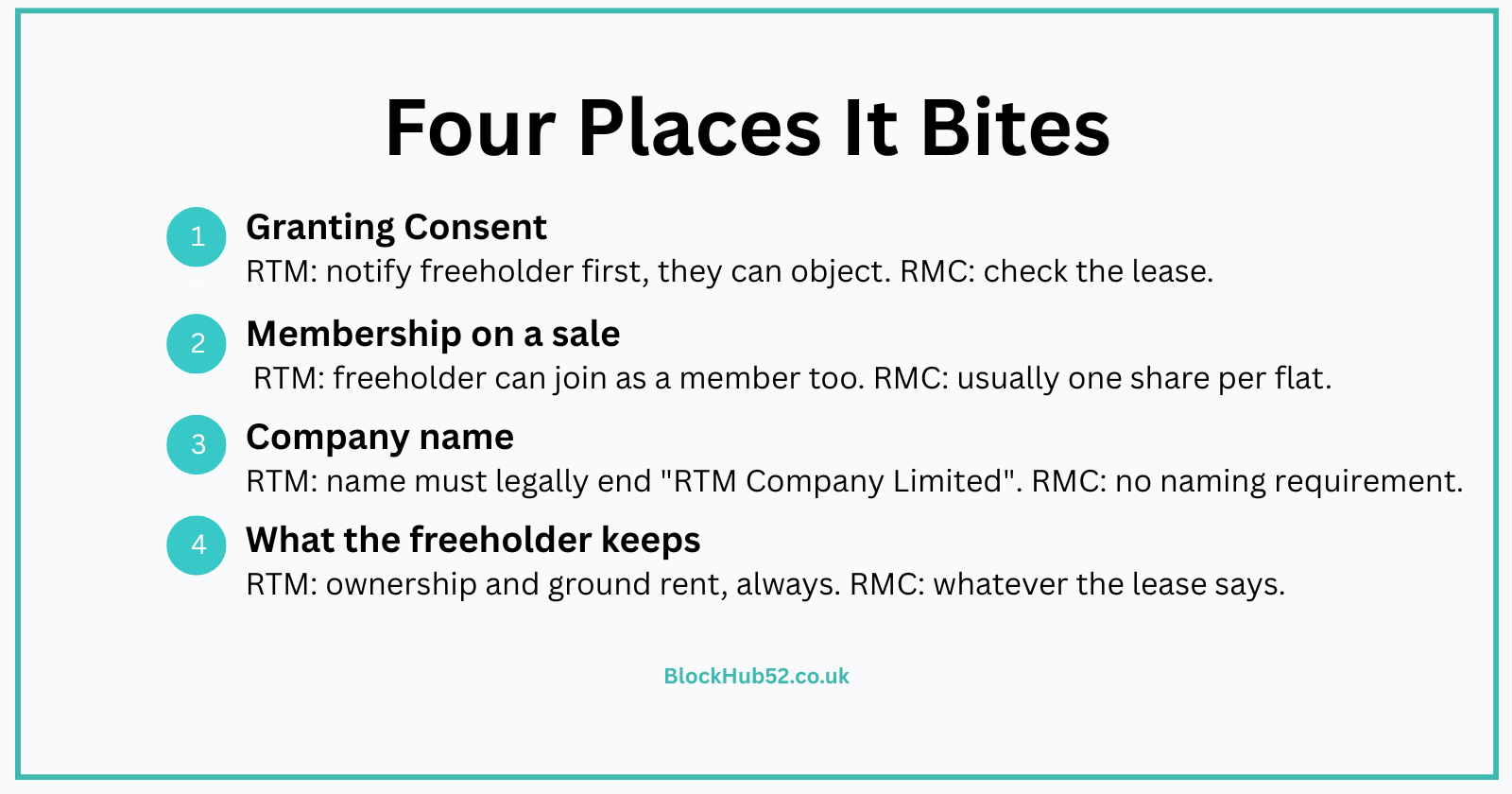
1. Granting Consent to a Leaseholder
A leaseholder wants to knock through a wall, sublet, or keep a dog, and the lease says they need permission.
If you're an RTM company, you hold the power to grant that approval, but the Act (section 98 of the Commonhold and Leasehold Reform Act (CLRA) 2002) requires you to notify the freeholder first, and for certain approvals the freeholder has a window to object. If they object, it can go to the First-tier Tribunal (Property Chamber). You can't simply say yes on your own.
If you're an RMC, whether the freeholder has any say depends entirely on how the lease is written. Some leases let the RMC grant consent outright; others require the freeholder to sign off. You read the lease, not the Act.
2. Dealing With a Leaseholder in Breach
A leaseholder is in serious, persistent breach, unpaid charges, unauthorised works, and you're considering the ultimate sanction.
Here the difference is stark. In one tribunal case, an RTM company applied to have a leaseholder's breach formally determined so forfeiture could follow. The tribunal held that only the landlord can forfeit a lease, the RTM company couldn't make that application at all. An RTM company can monitor and chase breaches, but the forfeiture power stays with the freeholder. If you want to go that far, you route it through them.
An RTM company can monitor and chase a breach, but only the freeholder can forfeit a lease. Holding management does not mean holding every remedy. Although there has been a recent case where the RTM was given power to forfeit a lease.
An RMC's position, again, depends on the lease and whether the RMC has direct enforcement rights written in. The point: don't assume that holding "management" means you hold every remedy.
3. Who Counts as a Member, and What Happens When a Flat Is Sold
In an RTM company, membership is open to every qualifying leaseholder, governed by statutory model articles. When a member sells their flat, they usually resign and the buyer takes their place. The freeholder is also entitled to become a member, which surprises a lot of directors, because it means the very landlord you took management from can sit in your meetings and vote.
In an RMC, membership is whatever the lease and articles say. A common pattern is one share per flat that transfers automatically to the buyer on sale, so the new owner becomes a member without lifting a finger. Membership can also be restricted, or still include the developer.
4. What the Freeholder Keeps
With an RTM company, the freeholder keeps ownership of the building and any ground rent, keeps any function the Act doesn't transfer, and can't exercise the transferred functions without your agreement. It's a split: you manage, they own.
With an RMC, the relationship is defined by the lease. The freeholder and the RMC are sometimes closely linked, especially in the years just after a building is completed, occasionally they're even the same people.
Can an RMC Face a Right to Manage (RTM) Claim?
Yes, and this catches people out, because it sounds like leaseholders using Right to Manage (RTM) against themselves.
The trap is assuming an RMC always means "the leaseholders, working together." An RMC is a company, and a company can drift a long way from that ideal. It might be developer-controlled and never handed over. It might be dormant, or struck off, while a freeholder-appointed agent quietly runs the building badly. Its membership might be incomplete, with shares never transferred on sale, so control sits with a few original owners. Or one faction might hold the board and the rest can't shift them.
In any of those situations, the unhappy leaseholders can't simply "use the RMC", the RMC is the obstacle. Right to Manage (RTM) gives them a statutory route to take the management functions away from whoever holds them, with a fixed procedure and no need to prove fault. Because the Commonhold and Leasehold Reform Act (CLRA) 2002 transfers management functions from the current manager, and an RMC that's a party to the lease is a current manager, the RTM route works against an underperforming RMC just as it does against a freeholder. So being an RMC is no guarantee you'll never see a Right to Manage (RTM) claim.
Which One Am I?
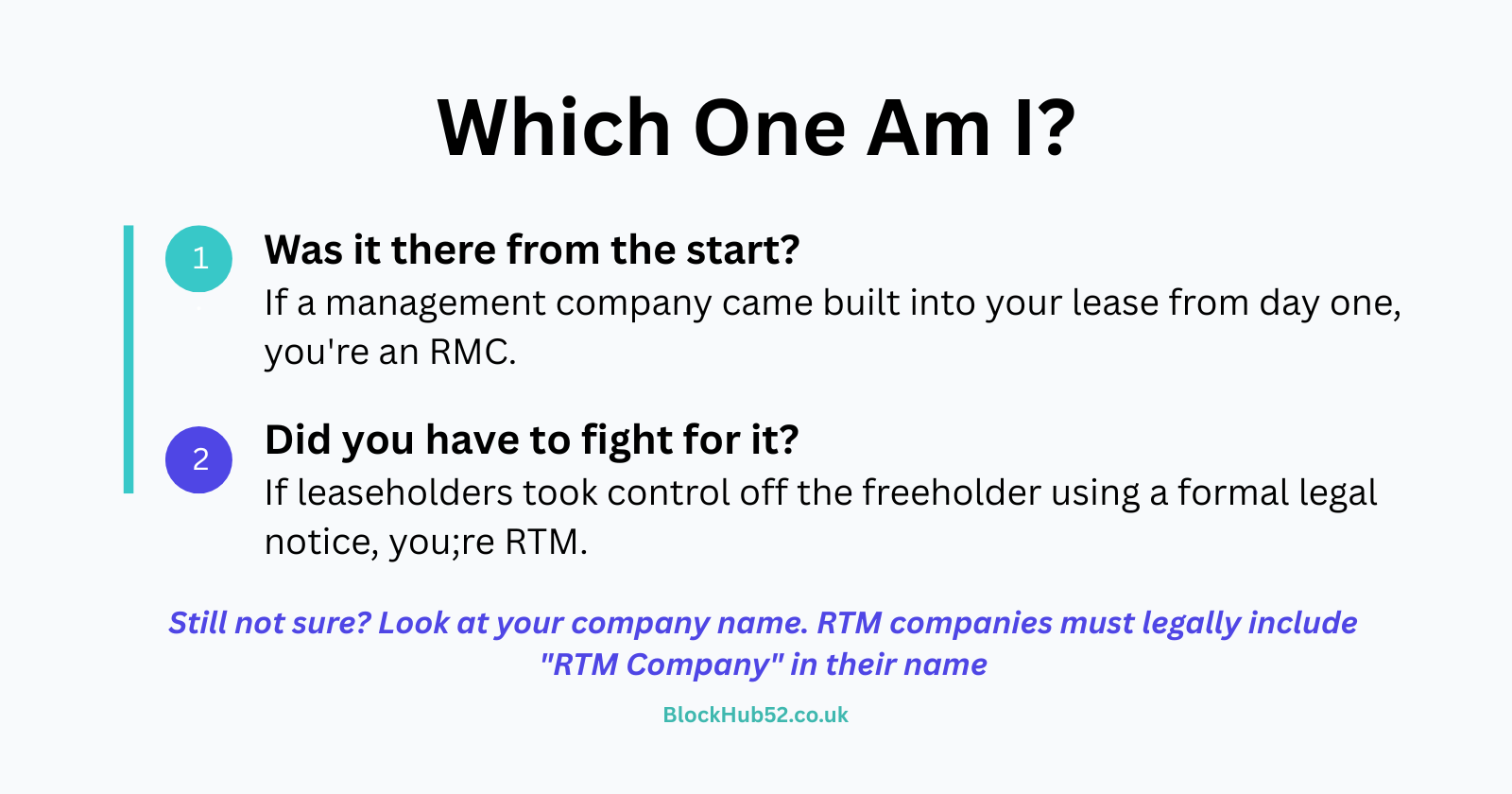
Two quick checks:
Read your lease. Does it name a management company as a party to the lease? If so, you likely have, or were meant to have, an RMC.
Check your company's history. Was it formed recently, specifically to take management off a freeholder, using a formal notice process? That's the signature of an RTM company.
Some buildings are both over time: an original RMC that had to run the Right to Manage (RTM) process to actually get control because the freeholder was blocking it, or an RTM company that later negotiated to buy the freehold as well. Your company name is a clue too, an RTM company's name must end in "RTM Company Limited" by law. But the notice history behind the company is what tells you which route you really took.
Where the Two Are Identical
One reassurance, so you don't over-worry the label. Once you're actually running the building, the money duties are the same for both. Service charge funds are held on trust for the leaseholders and kept separate from the company's own money. You must issue proper accounts, consult on major works and long-term agreements under the Landlord and Tenant Act (LTA) 1985 (the Section 20 process), and serve valid demands. None of that changes based on whether your authority came from the lease or the Act. The company type decides your powers; it doesn't soften your duties.
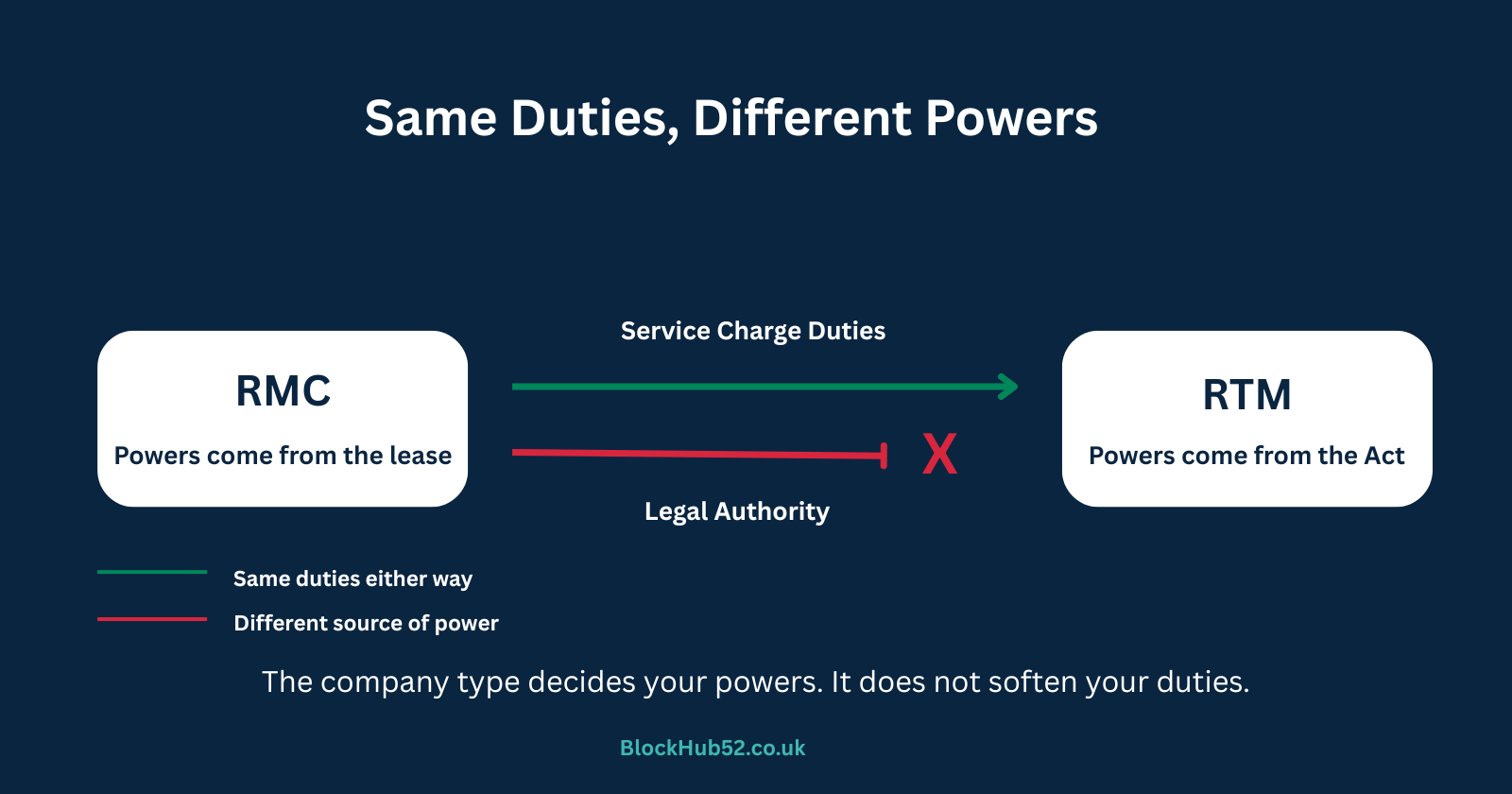
The company type decides your powers. It does not soften your duties.
Frequently Asked Questions
Is Right to Manage (RTM) the Same as Owning the Freehold?
No. It transfers management functions only. The freeholder keeps ownership and any ground rent. Buying the freehold is a separate process called collective enfranchisement.
Can Leaseholders Use Right to Manage (RTM) Where an RMC Already Exists?
Yes, in the right circumstances. If the existing RMC is developer-controlled, dormant, or simply not performing, Right to Manage (RTM) can be used to take control, because the right isn't limited to freeholder-managed buildings.
Do RTM Companies and RMCs Have the Same Service Charge Duties?
Yes. Both hold service charge money on trust, must produce proper accounts, and must run the building in line with landlord and tenant law. The company type doesn't change these.
Which Is More Common in New-Build Flats?
RMCs. Developers often build the management company into the lease from the start. Right to Manage (RTM) tends to come later, in older buildings where leaseholders decide to take management off an underperforming freeholder or agent.
Do I Really Need to Know Which One I Am?
Yes. It decides which document governs your powers, the lease for an RMC, the Act for an RTM company, so it's worth confirming early rather than assuming.
Where to Start
Whichever route brought you here, the compliance and accounting duties are the same once you're running the building:
- Free UK Block Compliance Wall Chart. The most important statutory deadlines in one page.
- Book a free call about your building. If BlockHub52 is a fit, you get 45 days free to try it. Service charge tracking and compliance built for self-managing RTM and RMC directors, so the accounts, the funds and the audit trail are correct.
Related Reading
BlockHub52 provides general information only. Nothing here is legal or financial advice. Always take independent qualified advice for your own situation.